
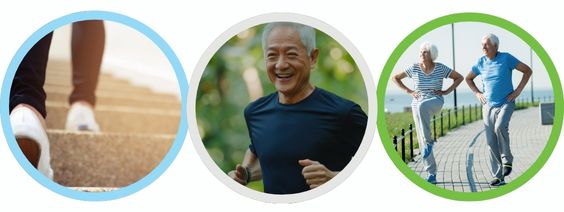
For many people living with neurological conditions such as stroke, Parkinson’s disease, MS, brain injury or neuropathy, the idea of running again can feel out of reach. But in the right environment, with the right support, high-level mobility is possible, and many clients surprise themselves with what they can achieve.
Why Running & Fast Walking Matter
Running or even jogging a few steps isn’t just about fitness. For many people, it represents:
- Independence
- Confidence in your body
- The ability to keep up with life, work, family, or sport
- Feeling like “your old self”
- Joy in moving freely at adapt to different speeds
And from a rehabilitation point of view, higher-level mobility helps improve:
- Leg power
- Balance
- Speed and safety with everyday tasks
So even if you never plan to become a runner, training the skills needed for running can hugely improve day-to-day mobility.
What Your Body Needs to Run
Running and fast walking rely on a few key muscle groups:
- Strong calves – These help you push off the ground and move forward with power.
- Hip muscles that quickly lift your leg – These give you room to swing your leg through without tripping.
- Hip and leg muscles that help you land safely – These muscles absorb impact, protect your joints, and help with balance and stability.
- Pelvic and core muscles – These keep you upright and stable when you’re moving quickly.
When these muscle groups work well together, walking feels easier, and higher-level activities like jogging or running become possible.
To improve fast walking, jogging, or running, your training needs to match the action itself, which means:
- Quicker movements
- Power-based exercises
- Single-leg balance
- Dynamic and unpredictable activities
- Practicing walking quickly or jogging in short bursts
- Drills that challenge speed and confidence
How We Assess Whether You’re Ready to Run
Before introducing jogging or running, we make sure you can:
- Walk at a safe and steady speed
- Balance on one leg safely
- Take quick steps without fear
- Land with good knee control
- Move with enough power to push off the ground
We may also use mini assessments like:
- Bounding practice (gentle one-foot hops)
- Quick-step drills
- Supported treadmill jogging
- Stair climbing
- Video analysis to see how each joint moves
This helps us safely decide what components of running or fast walking practice is right for you.
Everyone’s journey is different, but your body can learn, adapt, and get stronger – even many years after your diagnosis or injury.
We meet you exactly where you are, and build up safely, step by step.
If you would like help exploring whether running or high-level mobility training is right for you, we’re here to guide you safely, supportively, and confidently – every step of the way.